ACCA Vs MBA 2026
Choosing between ACCA and an MBA in 2026 is not really a question of which qualification is “better.”
The more useful question is:
Do you want to become a finance specialist, or do you want to build a broader management career?
ACCA is designed around professional accountancy, financial reporting, audit, taxation, financial management and related finance capabilities. An MBA, particularly from a strong business school, is designed to develop broader management capabilities across areas such as strategy, marketing, operations, finance and leadership.
That difference becomes important when you look beyond the qualification itself and compare cost, time, salary potential, career mobility, employer demand and long-term career direction.
In 2026, the comparison is also becoming more interesting because ACCA is preparing for a redesigned qualification that introduces stronger emphasis on employability, technology, data, sustainability and practical skills, with the first exams under the new structure scheduled for 2027.
Choose ACCA if you want depth in accounting and finance.
Choose an MBA if you want broader management exposure and access to management-oriented career paths — but the value of the MBA depends heavily on the quality of the institution.
For a finance professional, the decision should therefore not be based simply on the letters after your name.
It should be based on what role you want to hold five to ten years from now.
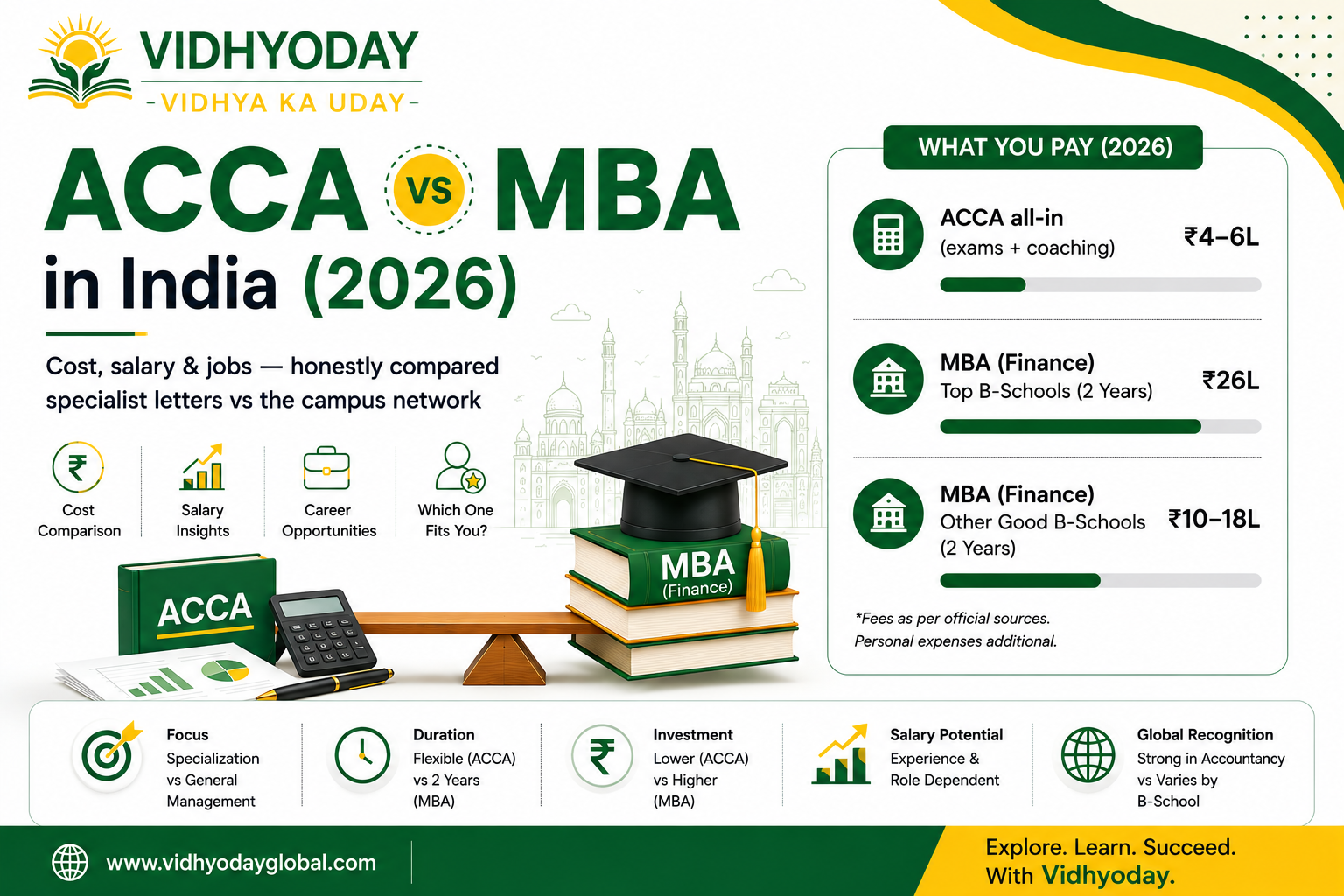
ACCA vs MBA at a Glance
| Factor | ACCA | MBA |
| Primary focus | Accounting & finance | Management & business |
| Qualification type | Professional accountancy qualification | Postgraduate management degree |
| Learning style | Exam + practical experience | Classroom + projects + internships |
| Typical duration | Flexible; depends on exemptions and pace | Usually 2 years for a full-time Indian MBA |
| Cost | Generally lower than a top-tier residential MBA | Can range widely; top schools are expensive |
| Career direction | Finance specialist | Management/generalist |
| Strong areas | Accounting, reporting, audit, tax, finance | Strategy, consulting, leadership, marketing, operations, finance |
| Flexibility | High | Depends on programme |
| International relevance | Strong professional accountancy pathway | Depends significantly on institution and programme |
| Best suited for | Finance-focused careers | Broader management careers |
The comparison is therefore less about ACCA vs MBA and more about specialisation vs breadth.
Add a caption (optional)
What Does ACCA Actually Train You For?
ACCA is fundamentally a professional accountancy qualification.
Its curriculum develops capabilities across areas such as financial accounting, management accounting, taxation, financial reporting, audit, financial management and strategic business leadership.
The existing ACCA pathway requires exams, the Ethics and Professional Skills Module and three years of relevant practical experience for membership.
The qualification is also becoming more technology- and employability-oriented.
ACCA's redesigned qualification introduces three main levels — Knowledge, Expertise and Strategic Professional — supported by employability modules and practical experience. It also incorporates areas such as data analysis, digital technology, sustainability and AI-related skills.
The practical outcome
ACCA is particularly relevant if you see yourself working in areas such as:
- Financial reporting
- Controllership
- Audit
- Internal audit
- Tax
- Financial planning and analysis
- Management accounting
- Treasury
- Finance operations
- Risk and controls
- Finance transformation
It gives you depth.
ACCA_vs_MBA_2026_Career_Decision_Guide.pdf
What Does an MBA Actually Train You For?
An MBA takes a different approach.
Rather than building primarily around one professional discipline, an MBA exposes students to a broader set of business functions.
Depending on the programme, this can include:
- Finance
- Marketing
- Strategy
- Operations
- Business analytics
- Human resources
- Leadership
- Entrepreneurship
- General management
For example, IIM Ahmedabad describes its two-year PGP as its flagship MBA programme and says its objective is to develop professional managers. Its student body includes graduates from commerce, engineering, science, medicine and other professional backgrounds.
That breadth is the biggest attraction of an MBA.
But it is also where one of the biggest misconceptions appears.
An MBA is not automatically valuable simply because it says “MBA” on the certificate.
The institution, programme quality, peer group, recruiter access, curriculum and placement outcomes can materially affect the return on investment.
ACCA vs MBA: The Cost Difference
Cost is one of the first areas students compare.
But comparing only tuition fees can be misleading.
You should consider:
Total investment = fees + preparation costs + living expenses + opportunity cost
ACCA
ACCA fees are generally paid progressively through registration, annual subscription, exam fees and other qualification-related charges.
For example, ACCA's published India fee information lists September 2026 Applied Skills standard-entry exam fees at £151 per exam. Actual total cost depends on the number of exams taken, exemptions, learning provider fees and other charges.
ACCA also offers considerable flexibility in how students study and when they take exams.
MBA
MBA costs vary enormously.
A two-year programme at a leading Indian business school can involve a substantial financial commitment.
For example, IIM Ahmedabad's published fee information for its PGP 2025–27 batch lists a programme fee of ₹27.5 lakh, including ₹20.1 lakh of tuition, while noting that personal expenses are additional.
And the financial cost is only part of the calculation.
A full-time MBA can also mean:
Two years away from full-time employment.
For someone already earning a salary, that lost income can become a significant part of the actual cost.
Plain takeaway
If your priority is keeping the financial investment and study format flexible, ACCA generally has an advantage.
If you are considering an MBA, the more important question is not:
“How much does an MBA cost?”
It is:
“What career and compensation opportunity does this particular MBA create relative to its total cost?”
ACCA vs MBA: Salary
This is where comparisons often become misleading.
You cannot meaningfully compare:
“Average ACCA salary”
with:
“Average MBA salary”
without considering experience, institution, industry, geography and the type of role.
An MBA from a top business school and an MBA from an unknown institution do not necessarily produce comparable career outcomes.
The same principle applies to ACCA professionals.
Consider the difference
An ACCA working in:
- Big Four audit
- FP&A
- controllership
- financial reporting
- investment-related finance
- multinational finance
may have a very different compensation trajectory from another ACCA professional working in a smaller accounting practice.
The same is true for MBA graduates.
An MBA graduate entering:
- consulting
- investment banking
- strategy
- product management
- corporate finance
- sales leadership
can have a very different compensation trajectory from someone joining a lower-paying general management role.
What Do Top MBA Placements Tell Us?
Top-tier MBA outcomes can be significant.
IIM Ahmedabad's 2025 MBA-PGP placement report reported a mean salary of ₹35.50 lakh and median salary of ₹34.59 lakh.
Its 2025–26 final placement process also attracted recruiters across consulting, banking, finance, technology, consumer businesses, healthcare, manufacturing, fintech and other sectors.
But this data should not be interpreted as:
“An MBA gives you ₹35 lakh.”
It means:
A top-tier MBA can create access to a very different recruiting ecosystem.
That distinction matters enormously.
The important caveat
Do not use the placement data of a handful of elite institutions to represent the entire MBA market.
This is precisely why IIM Ahmedabad participates in the Indian Placement Reporting Standards framework, which aims to make business-school placement information more comparable and reliable.
Which One Has Better Career Opportunities?
That depends on what you mean by “better.”
If you want finance depth
ACCA has the clearer alignment.
Potential paths include:
Accountant → Senior Accountant → Finance Manager → Financial Controller → Finance Director → CFO
Other specialist tracks can include:
Audit → Senior Audit → Manager → Senior Manager → Director/Partner
or:
FP&A → Finance Manager → FP&A Head → Finance Director/CFO
If you want management breadth
An MBA can provide access to a wider range of functions.
Possible paths include:
Consulting
Strategy
Corporate finance
Investment banking
Product management
Operations
Marketing
Business development
General management
Entrepreneurship
The advantage is mobility across functions.
The trade-off is that you may not develop the same depth in accounting and financial reporting that a professional accountancy qualification provides.
ACCA vs MBA for a Finance Career
This is where the decision becomes particularly interesting.
Suppose your long-term goal is:
CFO
Neither qualification automatically makes you a CFO.
A CFO needs much more than a qualification.
They typically need exposure to:
- Accounting
- Financial reporting
- FP&A
- Treasury
- Tax
- Controls
- Business strategy
- Cash flow
- Fundraising
- M&A
- Technology
- Leadership
- Stakeholder management
- Business partnering
ACCA can provide a strong technical foundation.
But an ACCA professional who wants to move into senior leadership must eventually develop commercial and leadership capabilities as well.
An MBA can accelerate the management side.
But an MBA professional moving into senior finance leadership may need to build deeper technical finance experience.
So the real equation is:
Qualification + Experience + Commercial understanding + Leadership
not simply:
ACCA vs MBA
What If You Already Have a Finance Qualification?
This changes the decision.
For someone who already has a strong finance foundation, an MBA may provide more incremental value if the objective is to move toward:
- Strategy
- Business leadership
- Consulting
- General management
- Investment banking
- Senior commercial roles
On the other hand, someone building a finance career from the beginning may find ACCA more directly aligned with their desired technical path.
The answer depends on what capability is missing from your current profile.
ACCA vs MBA: Which Is Better for Freshers?
For a fresher, the decision should start with career direction.
Choose ACCA if:
- You genuinely enjoy accounting and finance.
- You want a finance-specialist career.
- You want a flexible study route.
- You want to build professional finance credentials while gaining experience.
- You are interested in accounting, reporting, audit or financial management.
Consider an MBA if:
- You want broader business exposure.
- You are targeting management roles.
- You want to enter consulting, strategy or other business functions.
- You can access a strong business school.
- You value the campus, peer network and structured recruitment ecosystem.
What If You Are a B.Com Graduate?
This is one of the most common situations.
A B.Com degree gives you a broad academic foundation.
The next step depends on what you want to become.
B.Com + ACCA
This combination can make sense for someone targeting a specialist finance career.
B.Com + Top MBA
This can make sense for someone targeting broader management careers.
B.Com + Low-quality MBA
This requires much more scrutiny.
The question should be:
Will the MBA materially improve my career opportunities compared with continuing to build experience and professional skills?
Do not pursue an MBA simply because “everyone does an MBA after B.Com.”
Can You Do ACCA and MBA Together?
Yes, but whether you should is a different question.
Doing both can make sense when the two qualifications solve different problems.
For example:
ACCA → technical finance depth
MBA → management and commercial breadth
But there is also a risk.
You can collect qualifications without developing enough real-world experience.
For senior finance careers, employers increasingly evaluate what you have done, not simply what you have studied.
So if you pursue both, experience should remain central.
The 5-Question Test
Before choosing ACCA or MBA, ask yourself these five questions.
1. Do I want to specialise in finance?
If yes, ACCA becomes more attractive.
If not, consider an MBA.
2. Do I want to manage a business or become a finance specialist?
Finance specialist → ACCA
Business/general management → MBA
3. Can I access a genuinely strong MBA programme?
If yes, the MBA may have significant value.
If not, compare its cost and opportunity cost against alternatives.
4. Am I willing to spend two years in a full-time programme?
yes, an MBA may fit.
If you prefer to work and study progressively, ACCA may If fit better.
5. Where do I want to be in 10 years?
Don't choose based on the first job.
Choose based on the career path.
ACCA vs MBA: The Real Trade-Off
The simplest way to think about it is:
ACCA builds depth.
MBA builds breadth.
ACCA is closer to:
“I want to become highly capable in finance.”
MBA is closer to:
“I want to understand and manage businesses more broadly.”
Neither statement is inherently better.
The better choice depends on the career you want to build.
So, ACCA or MBA in 2026?
Choose ACCA if you want:
- Accounting
- Audit
- Financial reporting
- Controllership
- Tax
- Finance operations
- FP&A
- Technical finance expertise
- A flexible professional qualification
Choose an MBA if you want:
- Consulting
- Strategy
- General management
- Broader business roles
- Product or commercial roles
- Leadership development
- Strong campus-based networking
- Access to structured management recruitment
Consider both if:
You want deep finance expertise and broader management capability, and you can build meaningful work experience alongside the qualifications.
Final Verdict
There is no universal winner in the ACCA vs MBA debate.
For a student who wants to become a finance specialist, ACCA can be the more direct route.
For someone targeting broader management or business leadership, a strong MBA can offer a wider career platform.
But one distinction should not be ignored:
The value of an MBA is highly dependent on the institution.
A top-tier MBA can provide access to recruiters, peer networks and career opportunities that are difficult to reproduce through the qualification alone. IIM Ahmedabad's 2025–26 placement cycle, for example, included recruiters across consulting, finance, technology, consumer, manufacturing and other sectors.
ACCA, meanwhile, is built as a professional accountancy pathway and is evolving toward stronger integration of technology, data, sustainability and employability skills.
So don't ask:
“Which qualification is better?”
Ask:
“Which qualification builds the capabilities and career access I need for the role I want?”
That is the better 2026 decision.
Frequently asked questions
Difference Between ACCA
ACCA
asdd
dfgnjm,,..
Ask our ACCA experts — we reply within a day.